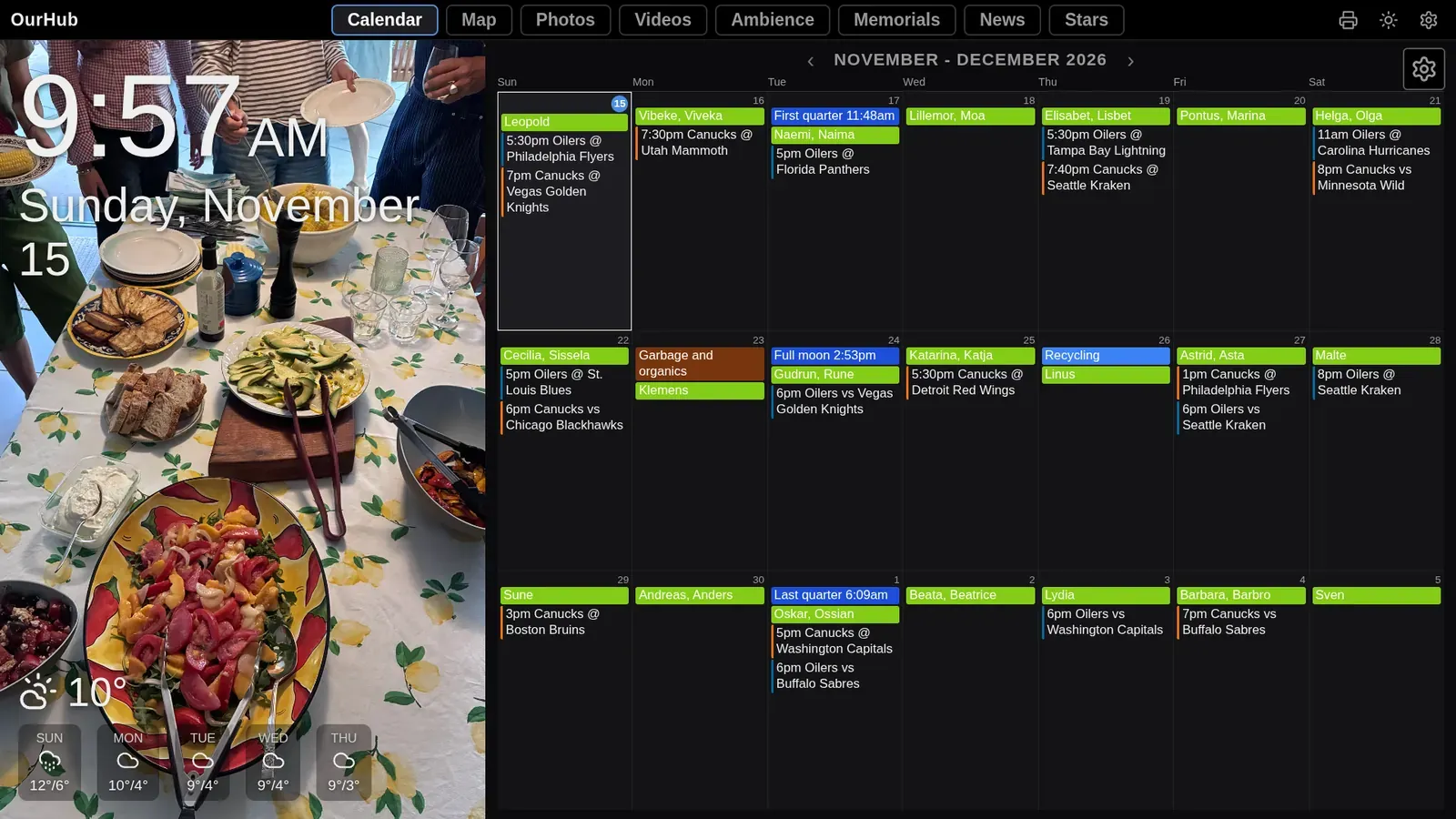
OurHub: a DIY household smart wall calendar, gallery, and star guide?!
A proof-of-concept family wall display for calendars, photos, memorials, maps and news, and what I learned building it with AI coding tools.

Charles Burnett
Background
We were killing ourselves keeping 2-3 paper wall calendars up-to-date with our multiple online (Proton, recycling, Canucks games) calendars. I tried some smart wall calendars at friends' homes and was both impressed but not interested in more subscriptions.
The idea of a DIY project that involved both code and hardware really appealed to me! And, I already had ideas how we could extent it beyond a handy digital monthly calendar - into a real hub of information.
My first attempt used MagicMirror² and its community modules. They were too rigid to reliably fill a screen region, which was the whole point of the display. So I wrote my own: a small Node and Express app with plain HTML, CSS and JavaScript, no framework and no build step. CSS Grid fills its container natively, which was the problem the modules couldn't solve.
The result is OurHub, a proof of concept with a public brochure at ourhub.dev.
Implementation Highlights
One screen, many pages. It began as a month-grid calendar merged from several feeds beside a rotating photo. It grew into photo albums, videos, ambient scenes, memorials linked to OurObit, a map with driving and biking routes, a news grid and a star guide.
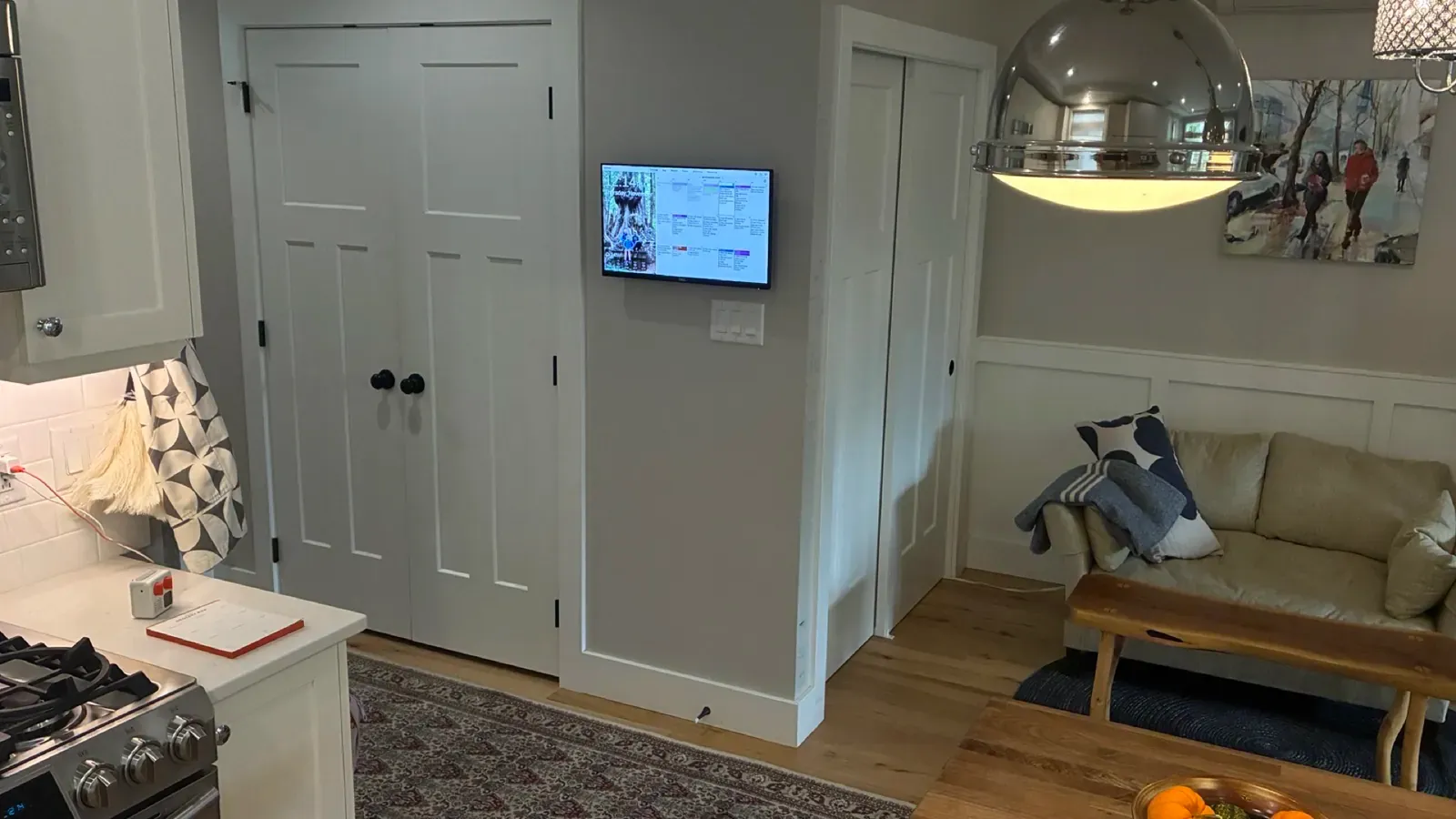
Server and display are separate. Midway through I split the two. The server runs as a Docker container on a home NAS that already hosts the photo library, and any browser can be the display. First it was an iPad, and now a Raspberry Pi 4 driving a touchscreen on the kitchen wall.
Privacy by design. Calendar links often carry a secret in the URL, and the photo library has an API key. Both stay on the server and never reach the browser. New calendars default to "sensitive", the photo panel can be limited to chosen albums, and the whole hub sits behind a login.
A news page that doesn't need an agent. I asked for an "AI news agent" and ended up with a workflow instead. Code does the fetching and one model call judges new items, with a daily spend cap, page text hashed so unchanged pages cost nothing, and links always taken from the source and never from the model. A real run over about ten sources cost about $0.12.
Measure first. When moving between pages felt slow, I measured before fixing anything. A calendar feed refetch was taking over a second, and a fade-in was adding more than a second to the photos page. Caching on the server and in the browser made it feel snappier.
A one-page brochure. ourhub.dev is a hand-written page on a Cloudflare Worker. The contact form uses Turnstile and Resend, and the screenshots were redone with public calendars to keep family details off the site.
AI Support
I built this with Claude Code, and the project taught me about working with agents and a lot about Node.
- Notes between sessions. As with OurObit, I kept
admin.md,service_plan.mdandbuild_log.mdin the repo. Each build log entry records what changed, what broke and what was not verified, with the session cost. - Cost stayed modest. Individual feature sessions cost from under a dollar to a few dollars, and the news feature cost about $8 to build.
- Looking before building. Before any code, the agent probed real feeds. That showed some feeds were dead and some sites forbid scraping, which changed the plan.
- AI with open-source libraries. I thought the Star Guide page would take much longer to build, but we found several libraries and leveraged astronomy-engine to make a star diagram quickly. It is an MIT-licensed library that calculates the positions of the Sun, Moon and planets offline, with no network or API key, and the chart itself is plain SVG. The positions of the bright stars and constellations are only right to a fraction of a degree, so the chart means "roughly where" rather than a precise planetarium.
What's next
The brochure site is live. Still to do: sheet music display and tutor, a family tree, a shared grocery list, and a second version of the news feeds. If you'd like to know when OurHub is ready for other households, there's a contact form at ourhub.dev.